
Trace Former Chickasaw County Owners by Transfer
Start with the newest deed that touches the parcel. Every row of your timeline should carry the recording date, grantor and grantee, deed type, and the book/page or instrument number. Treat the table as a map to sources, since gaps in any given year can appear.
| Transfer date | Grantor to grantee | Deed type | Reference to preserve |
|---|---|---|---|
| Newest filing | Current deed's grantor to current grantee | As indexed | Instrument plus book/page |
| Prior filing | That grantor's seller to that grantor | As indexed | Instrument plus legal description |
| Earlier filing | Repeat the linked party sequence | As indexed | Book/page and district |
| Pre-index era | Names found through deed-book indexes | Read from volume | Volume, page, date, land text |
For recent First Judicial District transfers, the online Delta index is the quickest starting point. Remember that 2008 only marks the online window. Earlier property history lives on at the Houston or Okolona courthouse and in archival deed records.
Use Chickasaw County's 2008-Present Name Index
Delta takes grantor or grantee names in last-first order. It also offers far more than a name search. You can hunt by partial name, filing date, or instrument number. Book/page, subdivision, block and lot, and section, township, and range work too. Filters narrow results by party role, date range, book range, instrument type, or land description. The portal lists no guaranteed image price or official-copy fee. It also cautions that uploads can lag and omissions happen. Note down the index reference. Then request the official instrument at the clerk counter instead of treating the screen as the chain of title itself.
See the Chickasaw County Deed Search Form
The First Judicial District deed-index source lays out the search routes you can use to reconstruct a parcel's former owners of record.
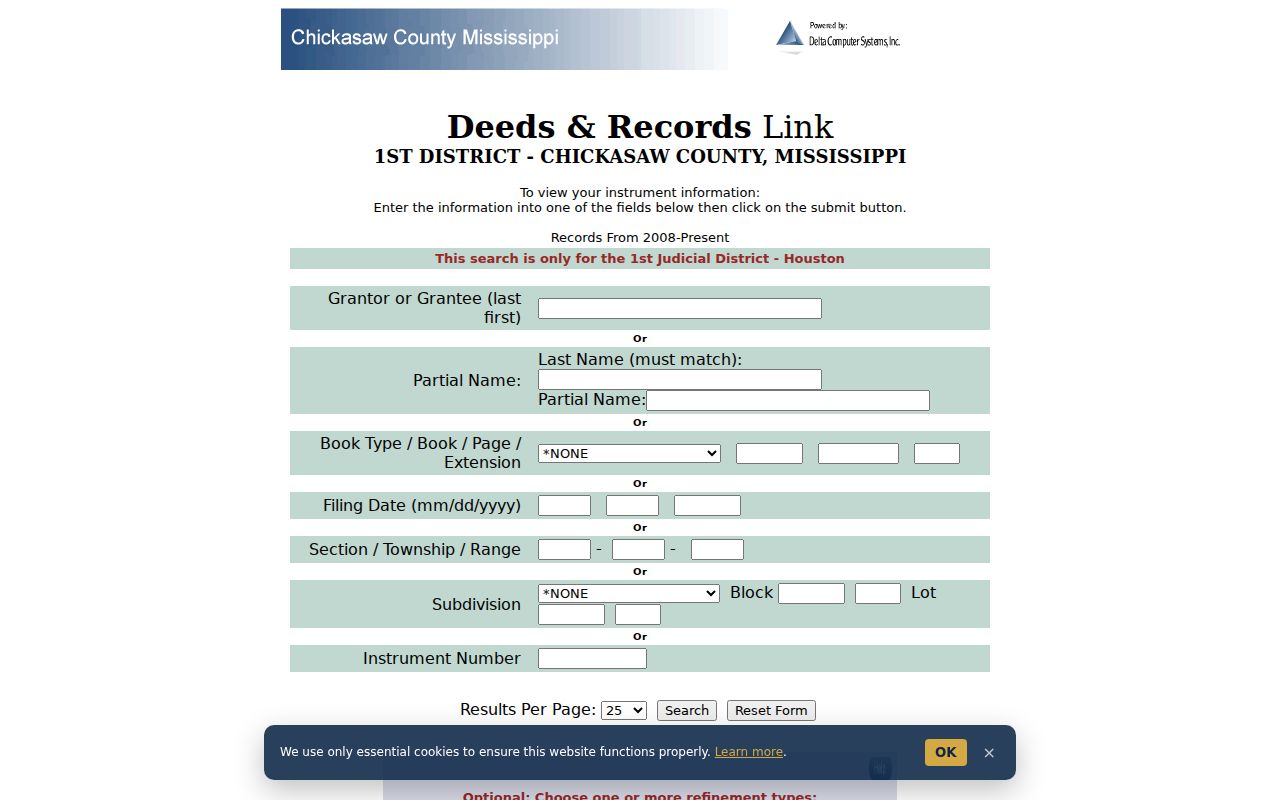
The form's subdivision and public-land-survey fields help when an old name was spelled or formatted in an unexpected way. Those fields let the deed search stay productive. A single typo should not end the trail.
Note: Search both party roles and both judicial districts before treating a missing online result as a break in the chain.
Reconstruct Chickasaw County's Ownership Chain Backward
Start from a matched parcel and its latest deed, not from a familiar surname alone. Names repeat across Chickasaw County. The legal description is what proves that successive deed records describe the same land, even when the address shifts or the owner of record appears under a slightly different name.
- Find the latest deed and record the current grantee, prior grantor, date, and land description.
- Search that grantor as a grantee to locate how that party acquired the same parcel.
- Repeat while preserving instrument number, book/page, deed type, and district for each link.
- At the online cutoff, use the relevant general index and deed book at the courthouse.
- Grantor and grantee
- The conveying party and receiving party named in the deed.
- Reverse index
- A party index organized from the grantor side.
- Chain of title
- The linked sequence of instruments affecting ownership.
- Warranty and quitclaim deeds
- Different conveyance forms whose legal effect must be read from the instrument.
Continue Former Chickasaw County Owners Beyond the Web
Chickasaw County splits its deed records between two courthouses. Call Houston at 662-456-2513 for First Judicial District books. Call Okolona at 662-447-2092 for Second Judicial District material. Give staff names in both party roles, a year range, the legal description, and the index or instrument type you need. Ask about general deed indexes, sectional indexes, Map/Plat Books, will books, and older volumes.
The MDAH county-record microfilm catalog offers an archival route when the courthouse book is impractical to inspect. MDAH treats microfilm as self-serve in its Media Room. Case files work differently. Those require a call number and a box request.
At the clerk counter, ask which series fits the problem. Options include general deeds, deeds of trust, substitutions, the sectional index, the Map/Plat Book, lis pendens, lien notices, judgments, the Chancery docket, and Will Books. Each does different work. A deed of trust may explain financing without conveying the interest a deed conveys, and a will or court order may explain why no ordinary sale joins two owners of record.
Copy and certification fees are not posted in the official sources. Ask separately about inspection, a plain copy, and a certified copy. Also confirm the district counter holds the volume you want before traveling.
Search MDAH for Older Chickasaw County Owners
The Mississippi archives catalog is a source route for Chickasaw County microfilm and older property records.
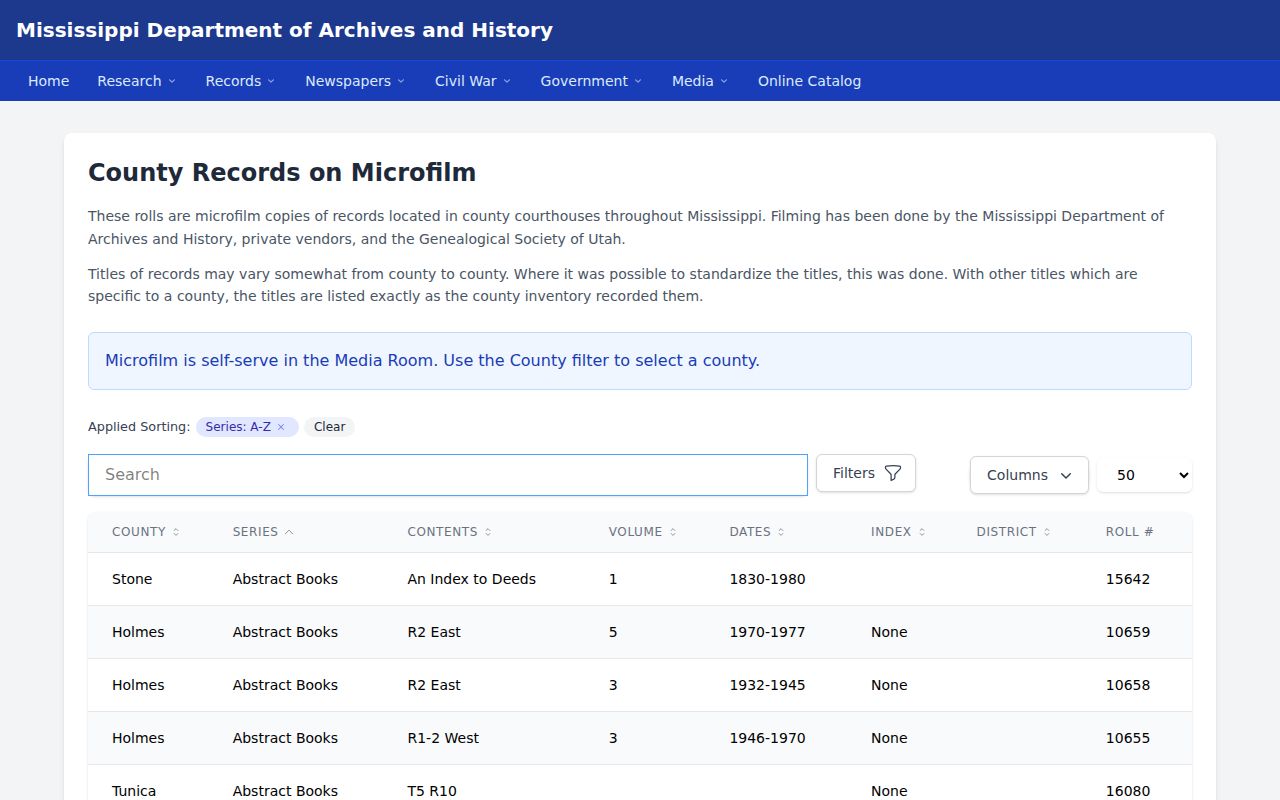
Archive entries work as leads, not proof of who owns land now.
The 1863 Break in Chickasaw County Ownership History
Chickasaw County ownership history has a hard break. Union soldiers burned a wagon of county land and public records on April 21, 1863. Any chain of title crossing that period will show a gap. Mark the exact missing link rather than the whole sequence. Then rebuild around it. Later deeds that recite earlier ownership help, and so do tax rolls, patents, probate orders, and other independent records. MDAH Series 1202 supplies some of the earliest material. Its tax-roll runs include combined 1836-1838 and 1840-1841 records, plus land rolls for 1842, 1845, 1848, and 1853. The Chickasaw Cession Land Office books span 1834-1846 and list names, township, section, range, notes, and plats. These sources add real context. Still, a name on a tax roll is not a deed transfer by itself.
Pair Chickasaw County Deeds With Local History Sources
Local history groups fill gaps the deed books leave open. The Chickasaw County Historical and Genealogical Society runs landowner and patent projects, Times Past abstracts, cemetery work, and marriage references. The Society also holds copies of historical courthouse material. Those are strong leads for house history and heir research. They matter most when a surname changed or a courthouse link stays unclear. Classify every item you use. Is it an original, an index, an abstract, or a transcription? Check a local-history clue's date, spelling, and land reference against the deed books. Only then does it belong in your timeline. Directories and newspapers serve a narrower role. They can explain an occupant, a business name, or an obsolete address. But they prove little about title. Note the publication title, year, coverage area, street index, and any owner notation. Then go back to the parcel's legal description. A street renumbering, railroad relocation, or postal-name shift can splice two unrelated properties into one. Search entity names with exact punctuation and common abbreviations. For a trust or estate, search a trustee or personal representative only when a public instrument supplies the name. That discipline keeps historical work grounded in records. It avoids guesses about family or business ties.
How Far Back Former Chickasaw County Owners Can Be Traced
No single date fits every parcel. Some Chickasaw County chains break at the 1863 destruction, and earlier stretches depend on older deed books plus archival tax and cession volumes as supporting evidence. Online access starts in 2008. For years before that, stop at the last supported link rather than filling a gap with inference.
Older records require older channels. The 2008 cutoff limits the online index only. Use courthouse deed books, microfilm, and archives for prior owners, and never use the results to harass anyone.
Probate can interrupt the pattern. The Fourteenth Chancery District MEC has handled Chickasaw County probate since 2021, and older probate files may take courthouse or archival inquiry to reach.
Keep a source log. For each former owner, record the spelling used, the party role, the transfer date, the deed type, the instrument or book and page, the district, the legal description, and where the image was inspected. Flag supporting records honestly. Tax rolls, directories, obituaries, patents, and plats are supporting records, not deeds. Say so when a source only narrows a year or hints at an heir. That discipline keeps a plausible story from becoming an unsupported claim, and it lets another researcher or clerk reproduce the chain.
Conflicts still happen. Prefer the record with the best land match and the best documented date, but preserve the conflict in your log. A later deed recital can light up an older gap without proving that every missing transfer was recorded.